
A new Buddhist temple has recently opened near our house, and free meditation classes are always on offer. It’s a pleasant way to spend half an hour, and following a guided fantasy led by one of the orange-robed monks is pretty much guaranteed to lower your blood pressure a few points.
You’re required to sit on a straight-backed school chair, facing a gaudy altar covered in plastic flowers, fruit and shiny artefacts. Draped behind that is a badly painted backdrop showing a couple of rowdy-looking laughing Buddhas, some clouds, and more flowers.
The contrast with our local Church of England building could not be more stark. Hanging from various dark rafters are carvings of the crucified Christ, his tragic face downcast, his crown of thorns digging in to his brow. Almost every stained glass window shows one of his tortured saints, along with the gruesome means of execution.
Christianity – as it was taught to me - seems to be all about suffering, and a good Christian must wallow in it. When I was a child, “The Reader’s Digest” would be delivered to our cottage every month, full of lurid stories of American soldiers imprisoned by “the Japs” and “the Vietcong” and subjected to unspeakable tortures. Unspeakable, and avidly read.
I was reminded of those stories when I read “Foxe’s Book of Martyrs: Select Narratives”, published by the Oxford University Press, as part of the Oxford World’s Classics series.
At the time the book first came out in the sixteenth century, it was the only book that most Protestants would ever read, apart from the Bible itself. (As an aside, the Bible and “The Reader’s Digest” were pretty much all my Strict Baptist father ever read, four centuries later.)
Several editions were published, of varying length. According to the frontispiece of the OUP volume:
“At about four times the length of the Bible, the fourth edition is the most physically imposing, complicated, technically demanding and best illustrated book of the Shakespearean age. Although it contains an impressive array of genres, it is best remembered for its many moving accounts of the apprehension, imprisonment, interrogation and execution of Protestants who had been condemned as heretics.”
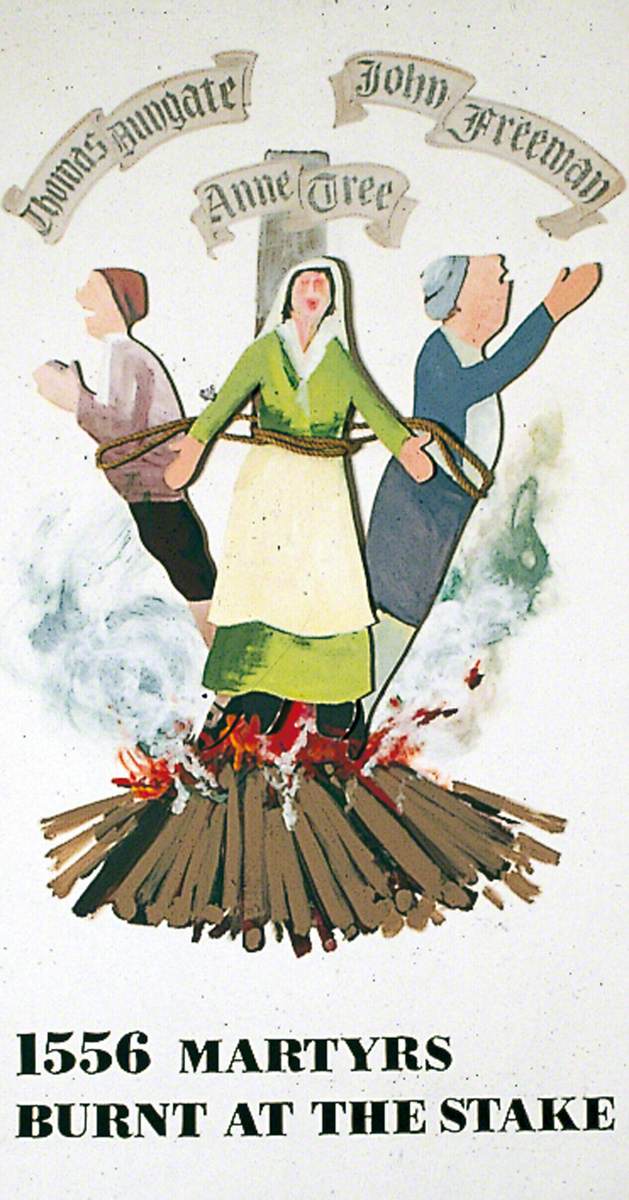
East Grinstead Millennium Mural Team; 1556 Martyrs Burnt at the Stake; Chequer Mead Theatre and Arts Centre Trust
As such, it is a tremendous piece of anti-Catholic propaganda which gave a massive push to English nationalism in defiance of foreign domination by popery. Foxe seems to me to have been a kind of proto-Puritan, who believed that God was using the English as special people to prepare for the Second Coming.
John Foxe lived from 1516/7 to 1587, an incredibly volatile time for Protestants. Henry VIII was persuaded to pursue Protestantism in order to secure his divorce from the first of his wives, Katherine of Aragon, but he was a religious conservative who remained attached to some Catholic tenets. His son, Edward VI, was seen as the ideal progressive monarch by Protestants like Foxe; but when he died, Mary I reinstated Catholicism and swiftly provided most of the martyrs described in Foxe’s book. Her successor, Elizabeth I, adopted a moderate Protestant path and never returned to the hard line of her half-brother.
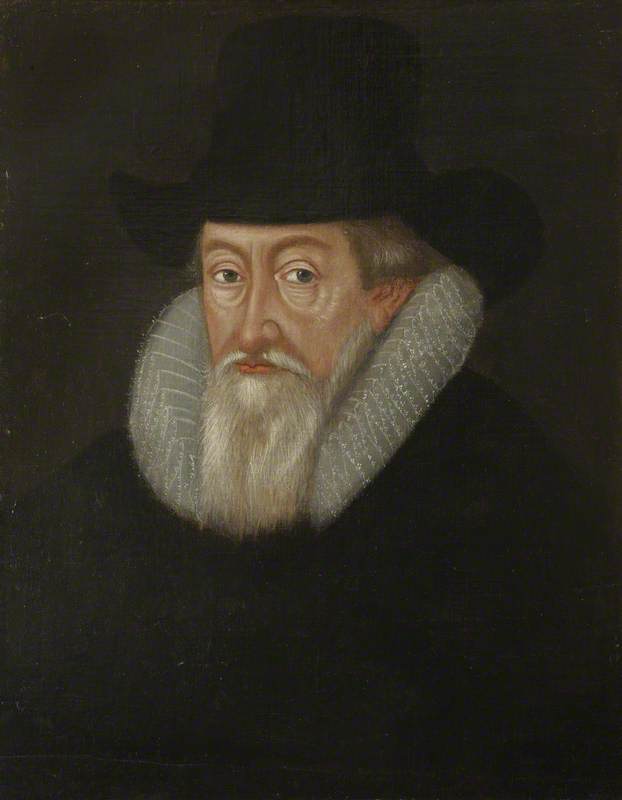
John Foxe (1516/1517-1587), Martyrologist; Corpus Christi College, University of Cambridge
Long after Foxe’s death, the emotional impact of his “Book of Martyrs” continued to be felt. Anti-Catholicism was rife at the time of the Gunpowder Plot, the Civil War and the Glorious Revolution; it made England a safe place for my Huguenot ancestors to take refuge in the 1680s.
Most potent in Foxe’s book of propaganda are the striking woodcuts, often of Protestants being burned at the stake, or otherwise tortured. They are pictured as true heroes and heroines, steadfastly refusing to recant. Examination of extant copies has shown that these illustrations were the most pored-over pages.
Irreverently, I can’t help thinking about the current trend for “mindfulness” adult colouring books when I look at these woodcuts. Each one is meticulous in its detail, and beautifully drawn, in spite of – or perhaps more correctly, because of – its gruesome subject matter: the publishers were committed to their purpose, and knew how to pack a punch.
Foxe’s Book of Martyrs certainly served to focus the Protestant mind. For a relaxing time this Christmas, however, you’d be better off with the Buddha and a nice colouring book:
Foxe's Book of Martyrs Select Narratives
Find out more about a Puritan upbringing here:
I thought the opening contrast between the Buddhist temple and the Christian church was a wonderful way of introducing this short guide to Christianity’s fascination with suffering and torture. Your account of Foxe’s Book of Martyrs shows how this fascination was developed in Protestantism, not to be outdone in this respect by Catholicism’s own stories and illustrations of martyred saints. It reminded me of the argument that Christianity is itself a form of torture worship, based in the thought of an all powerful father who is willing to see his son tortured in order to redeem the world.
As always, so thought provoking, Jo.
I should add that reading your earlier piece about the Puritans clarified the idea of being ‘chosen’.
What a wonderful and wacky opening – a delicious counterpoint to your theme that ‘Christianity seems to be all about suffering…’ As ever you give us a new perspective on the time. I had no idea that Foxe’s book of Martyrs was the only book most Protestants would read apart from the bible, despite being four times the latter’s length. Your flash forward to your father’s reading material is a fascinating parallel.
Interesting idea that Foxe could be seen as a proto-Puritan* whose view of the English as a special people gave a massive boost to English nationalism versus foreign ‘popery’. I feel uncomfortable echoes in the post Brexit era.
The pictures you have added to this site add to the drama of the story.
I hope one day you will find details of the sermons given by Alfred Barnabas Hall as I would love to read your dissenting view.
When there is/was so much poverty and suffering you would have thought a kinder religion would have helped people more.
* Not sure I was aware that the Puritans regarded themselves as a ‘chosen people’. A link to a definition might help here.
Remember that the poor had to be kept in their place, in this instance by – literally – putting the fear of God into them. I can’t give sources, but it’s acknowledged that Methodism was an antidote to Marxism.
Interesting paper by Joseph Cronin about the usual quote from Marx that ‘Religion is the opium of the people.’ From his ‘Contribution to the Critique of Hegel’s Philosophy of Right’ (1844) https://blogs.lse.ac.uk/religionglobalsociety/2018/05/still-an-opium-contemporary-marxists-versus-karl-marx-on-the-question-of-religion/
He discusses why today’s Marxists may suggest that modern Marxism is not opposed to religion – perhaps opportunistically-as “most economically marginalised groups, certainly in the UK but also across the globe, tend to have higher levels of religious observance. Why then would you want to alienate a potentially huge and receptive audience by telling them that their faith is an ‘opium’?” Cronin op cit.
As always I admire the way you manage to draw the reader into a whole world through the keyhole of one mage or event. Foxe’s Book if Martyrs was not part of my scene as a child. But at my Catholic boarding school we were each day read, as we struggled with our old porridge or rubbery frankfurters, gruesome episodes from the lives of saints, especially young girl saints who heroically resisted rapists and other fearsome men. A favourite tale was that of St Maria Goretti who was martyred at the age of 12. We all exchanged not football cards but holy cards, featuring suffering saints as well as the sorrows of Mary and Christ— all painted in garish colours which would have been the envy of your Buddhist worshippers. When it comes to suffering I suspect Catholicism outdoes Protestantism. And I haven’t even begun to detail the various and ingenious penances we were given or chose to inflict upon ourselves.
My own Strict Baptist girlhood was different in so many ways, yet your final point – “or chose to inflict upon ourselves” – is bang on. Messages are internalised and the child becomes her own persecutor.
Another fascinating blog, Huguenot Jo! I love the juxtaposition of the smiling Buddhas and the agonies depicted in Foxe’s book of martyrs. Interesting too how it was written at a time when the English were promoting a kind of exceptionalist philosophy which became ever more dominant and seems to have resulted in Brexit, to all our cost – at least in my opinion. I was also reminded of the wonderful novel by Jill Paton Walsh Knowledge of Angels in which the girl who has been brought up by wolves is shocked to the core by her first sight of the gruesome cruelty depicted in the crucifix she sees in the church. And she is supposed to be the savage. 🤔
I especially enjoyed the very clear overview you give of the history of Protestantism in this blog and the part that Foxe played. Anti Catholic feeling persisted for a long, long time.
It’s ages since I read Knowledge of Angels, but it came back to me very clearly from your comment – thank you!
I really enjoyed this, thank you. I just finished reading Hilary Mantel’s The Mirror and the Light, about last days of Thomas Cromwell, Henry VIII’s hatchet man.
Such brutal times. I agree with you to stick to the plastic orange flowers and smiling Buddhas!
“Hatchet man” is a great description, thank you! Plenty of hatcheting went on in Tudor times.
My avowedly humanist uncle had an old copy of Foxe’s book of Martyrs that I think he used to help confirm his view that religion never had nor ever would be a positive influence on the way people led their lives. Although the martyrs there were celebrated and may have gone happily to their death trusting there would be a place for them among the chosen in heaven a lot of ordinary people were caught up in the horrors depicted just as they are now when zealots try to persuade and then force obedience to their narrow path.
Ordinary people were kept in line by the example of the martyrs; as you say, such horrors are still going on. I like the sound of your uncle!
Think I prefer the Buddhist Temple .
Yes, altogether a more peaceful approach. Thank you!