
Poor old John Milton (1608-1674) was probably only in his late forties when he went blind, having had a tumultuous life up until then.
He was a Puritan and a propagandist both for Oliver Cromwell’s Republic and the regicides, using his impressive linguistic skills to write and translate for the revolutionary cause.
I bitterly envy those campaigning years of his, which must have stretched his capacity for languages and the mother tongue to the limit. It calls to mind what Wordsworth - who revered and echoed Milton - wrote of the French Revolution:
Bliss was it in that dawn to be alive,
But to be young was very heaven!
Milton hoped for Paradise on earth and put his shoulder to the wheel to make it happen. But after the death of Oliver Cromwell in 1658, the Republic crumbled; the Restoration of the Monarchy meant Milton had to go into hiding, and it was only through influential friends that he escaped life imprisonment or worse. A defeated, impoverished existence followed, made worse by a gradual loss of sight.
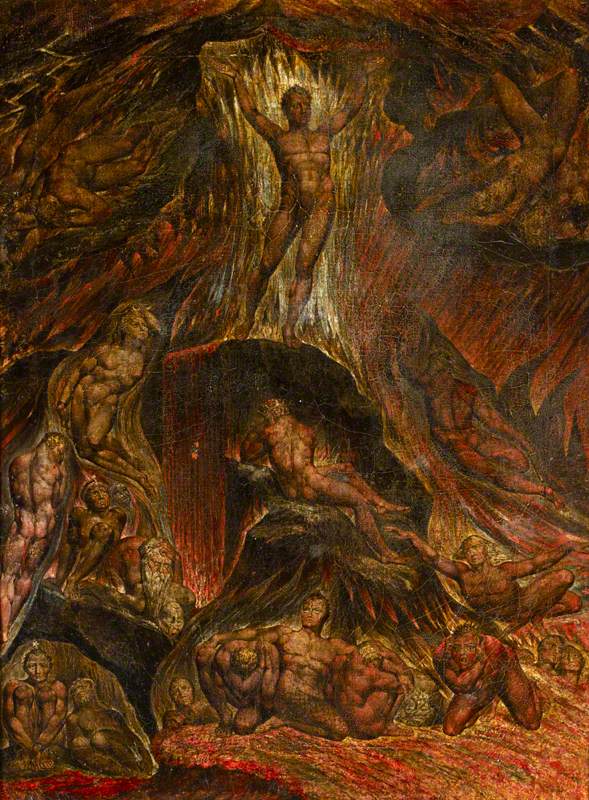
Satan Calling up His Legions by William Blake; National Trust, Petworth House
Nonetheless, during his two decades of blindness up until death, he wrote his best poetry, including the masterpiece “Paradise Lost”. Protegés, assistants and his own daughters were enjoined to take down what he dictated. His relationship with his daughters was poor – apparently he expected them to take dictation in languages they didn’t understand, and was angered by their inability to do so. Shockingly, he then disinherited them.
Milton’s nephew and first biographer Edward Phillips said that the poet’s third wife, Elizabeth Mynshull, “oppressed his children in his lifetime, and cheated them at his death.” Perhaps it was the work of their stepmother to drive a wedge between them; but perhaps, as a grumpy old man, he lost patience with them. Perhaps they lost patience with him. And yet in the midst of all this family angst, the most sublime poetry was produced.
Our dog, Wolfie, is in the last years of his life at thirteen, and is almost completely blind. You can see the milkiness of glaucoma in his eyes. It’s a sad thing that such a beautiful, bounding dog should be reduced to this. Border terriers like him were bred to run all day with the hunt. They rarely bark.
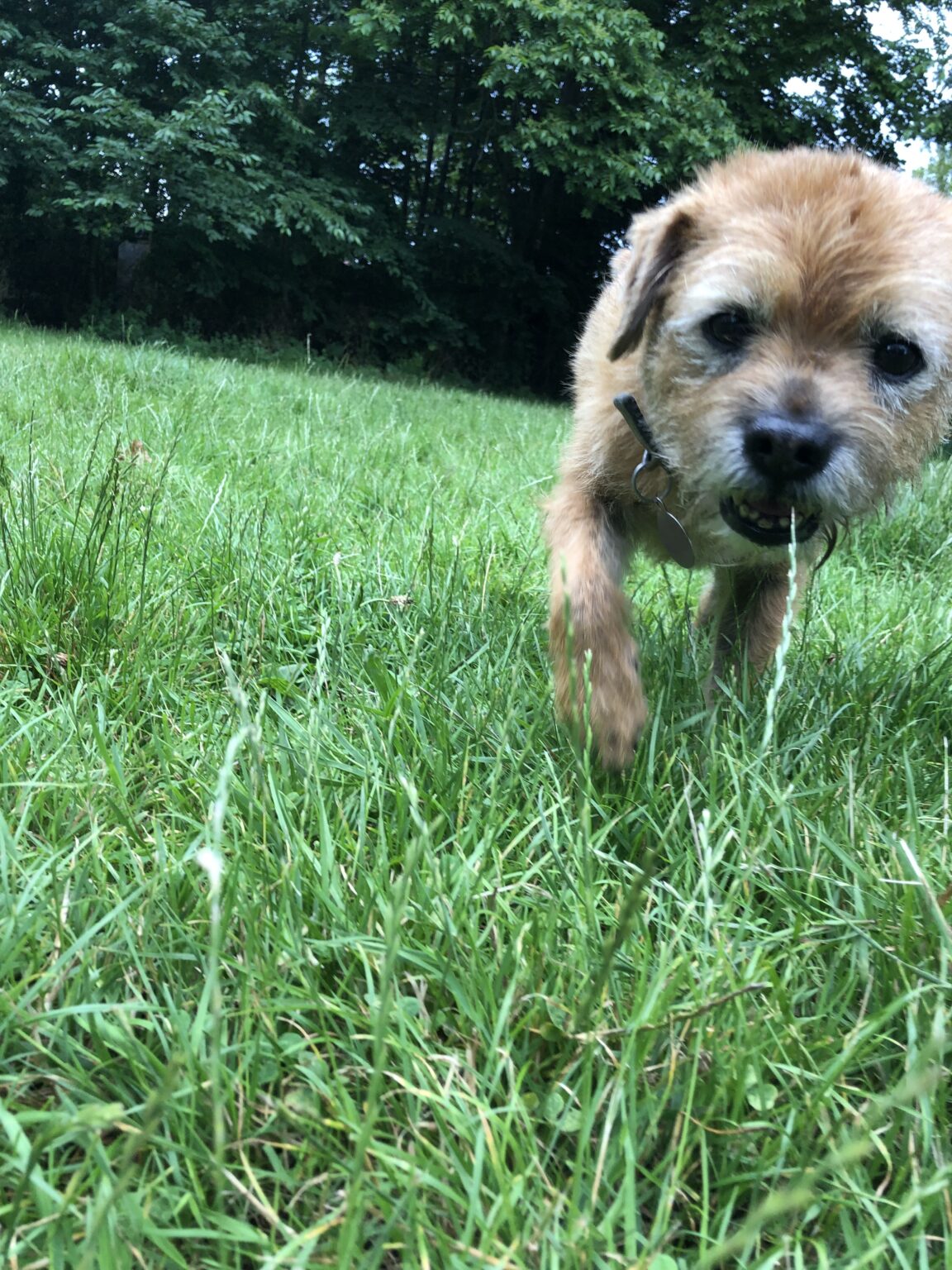
Wolfie has taken to issuing a single bark when he needs help – a loud, high-pitched yelp. He will stand motionless in the middle of our small garden and yip as if he’s forgotten the way home to the back door. His urgent need has made him more demanding, yet I jump to it. Indoors I don’t like to see him bump his head, so I rearrange the furniture to clear his path.
It makes me think that perhaps we have pets so that we can learn to grow old ourselves. A terrier’s life is packed into a dozen or so years, like a telescoped version of our own. Wolfie’s legs are wobbly, and sometimes they collapse under him. On other days, he bounds through long grass like a lamb.
Sonnet 19: When I consider how my light is spent
by JOHN MILTON
When I consider how my light is spent,
Ere half my days, in this dark world and wide,
And that one Talent which is death to hide
Lodged with me useless, though my Soul more bent
To serve therewith my Maker, and present
My true account, lest he returning chide;
“Doth God exact day-labour, light denied?”
I fondly ask. But patience, to prevent
That murmur, soon replies, “God doth not need
Either man’s work or his own gifts; who best
Bear his mild yoke, they serve him best. His state
Is Kingly. Thousands at his bidding speed
And post o’er Land and Ocean without rest:
They also serve who only stand and wait.”
Biographer Claire Tomalin wrote a beautiful piece about John Milton for The Guardian.
Another thought provoking post, Jo. Poor Wolfie. You make an apposite point about the aging of our pets as a lesson to us in our own slide south.
I recently encountered Milton in the form of a book hidden in the bottom of one of my mother’s cupboards as we clear her flat to sell and help finance her care. I remembered the volume from my childhood. It had been rebound by a neighbour- an elderly bookbinder and is a tome about 4 inches thick and perhaps 15″ x 10″. It came home pristine in its leather cover when I was about 10 years old and we opened it with curiosity only to be terrified by Gustave Doré’s illustrations. I have not explored it since…and hadn’t realised my mother had brought it with her when she downsized the first time twelve years ago.
Your post and Claire Tomalin’s article makes it all so much more accessible but it feels as though it needs a deal of time to venture into its depths….rather like deciding to make a good study of current issues in astrophysics. How and why the book came into our family is another question but I found it with another tome…my great great grandmother’s family’Self-Interpreting’ bible printed in 1830 by the evangelist, Professor John Brown of Edinburgh University. It boasted “2000 explanatory notes, numerous references and readings, with a complete index and dictionary.”
Has such a work been written about Paradise Lost? Even then it seems a daunting task to tackle but what a history, what a man, a monster perhaps but what brilliance.
It is sad watching a pet age; when my daughters were born we already had a cat, Gladstone, who was part of their childhood. As she lost her sight first in one eye and then the other through tumors they learnt not to move things around as she seemed able to memorize the layout of the furniture. We just had to help onto the chairs and our laps when she indicated that was what she wanted. After she died we waited a while going rapidly through numerous hamsters until we realized only two cats could fill the Gladstone sized hole in our lives.
I do hope Wolfie keeps going happily for a few years more.
What a charming and touching blog post. I must say I do not think J Milton would have been an easy companion if one had fallen short of his intellectual and religious standards. As a lifelong Cavalier I would not have been welcome at the Puritan court. How well though you have used his final years of blindness to draw out for your readers the sensitive and kind ways you providing for your much loved terrier in the last phase of life.