
Thanks to Black Lives Matter and the toppling of a Bristol statue, I’ve just found out about the part a number of Huguenots played in the transatlantic slave trade. All that Bible reading did such Huguenots no good when it came to the lives of stolen Africans.
We all like to glorify our ancestors. The Huguenots who fled France were the ones who would not renounce their religion; they stood their ground when required to convert and risked death for the Word of God. Surely they must have been conscientious, highly principled, philanthropic types.
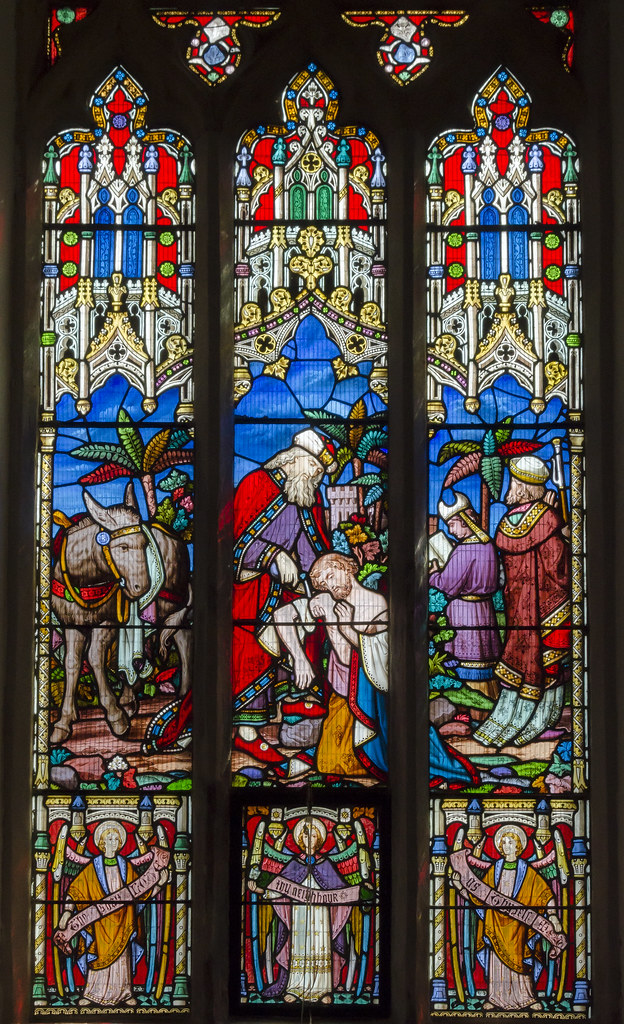
My lot – the Strict Baptists of proud Huguenot heritage, living in relative poverty – were obsessed by the story of the Good Samaritan, which admonishes Christians to help any human who has fallen by the wayside, regardless of race. Plenty of Huguenots, like Anthony Benezet and Samuel Romilly, were active abolitionists.
Huguenots were, however, at the cutting edge of capitalist society. Their crimes, when committed, were not the cheeky stealing of a pig or lamb.
Britain led the mass transatlantic slave trade from the mid-17th century onwards. Slave-ships left for Africa from ports like Bristol, Liverpool, London and Glasgow, took captured Africans to America, and returned to Britain with slave-produced commodities like cotton, sugar and tobacco. The slave-ship owners amassed huge wealth from this briskly cost-effective triangle.
In Bristol, the Huguenot family Laroche established itself as a leading investor in slavery. James Laroche and his nephew, also James Laroche, traded under the name “James Laroche & Co” - specialising in the lucrative new slave trade. In 1738 alone, the company made five transatlantic crossings, taking Africans to Jamaica, St Kitts and North Carolina. One in five of those slaves would not survive the journey.
The younger James Laroche was co-owner of The Black Prince, the most notorious of Bristol’s slave-ships. “The Log of The Black Prince”, written with shocking sang-froid by the ship’s captain and now held in Bristol Central Reference Library, has the following details for 1763:
17 February [1763] … found the slaves intended taking [the ship]- two slaves Discovered there Intregue putt most Part of the Men in Chains to prevent there Intention …
22 February … found the Slaves was intending to rise got all under arms and soon got them quieted tho a great Number of them had Broke there Irons … found out 2 of which was the Ring Leaders which was well Flogged …
3 March … Slaves is very indifferent with Colds and Purging … Woman No 11 died …
4 March … The slaves intended to make the other Attempt [uprising]. Am got up 10 of the Ring Leaders put them in one chain and whipt them … Died one girl of the flux No 12
7 March … Died the Ring Leader of the Insurrection …
8 March … One Woman is very bad, Many of them with purging and some falls away not eateing …
14 March … The slaves fore and aft falls away very much although no vizable complaint eat there vituals very well …
1 April … The Slaves still fall away and complain of gripeings and fluxes …
5 April … Many complaints forward one sick slave Endevered to Jump over Board …
It was on the backs of slaves that some of the richest Huguenot merchants in Bristol – the Laroches, and a dynasty called the Peloquins – rose to the top of Bristolian society through the Merchant Venturers, a quasi successor to the medieval guild. They trod a well-worn path to establish themselves and their families. According to “The Huguenots in Bristol” by Ronald Mayo:
“Members of the exclusive Merchant Venturers Society were also, in many cases, members of the self-electing Common Council and it was the exception rather than the rule if the Master of the Merchant Venturers of one year was not the Lord Mayor the ensuing one, or vice versa.”
The younger James Laroche was made a baronet and became MP for Bodmin from 1768 to 1780. After entering Parliament his financial position became increasingly unstable; this may have been because his slave-ship The Black Prince was hijacked – and ultimately shipwrecked – by mutinous crew. As an MP, he is listed in “The History of Parliament Online” and his entry reports his decline: in 1774 he mortgaged his wife’s estates in Antigua for £7,000. In 1779, “The Public Ledger” wrote of him:
“Was a Bristol merchant, and for doing some Government business there, was rewarded three years ago with a baronetage. He is lately become a bankrupt…and is now literally a beggar for the crumbs which fall from the minister’s table.”
Eventually recovering from the shame of bankruptcy, he stood for Bodmin again in 1790 but was defeated. He died in 1804. Had he held onto his fortune, and endowed a few schools in Bristol, he might have had a statue as well as a baronetcy.

Commemorative statuary is all over the news thanks to Black Lives Matter, an anti-racist movement sparked by the killing of black people by police in the USA. The murder of George Floyd on 25 May 2020 spurred new international impetus – helped by horrific video footage of George pleading for his life with the words: “Officer, I cannot breathe.”
In Britain, the statue of eighteenth-century slave trader Edward Colston was pulled down in Bristol, and tossed into the harbour. This act of civil disobedience followed years of formal objection and made the front pages; the statue has been pulled out, and will be displayed in a museum with explanatory notes about its own history.
In the wake of this dramatic protest, other institutions are scrambling to re-package their monuments. Hordes of archivists are beavering away nationwide – and indeed, worldwide – seeking words to contextualise statues of people who should never have been memorialized in the first place.
If the plaques get it right, tarnished old statuary will help people learn from history - not be stultified by it.
We lived in Kingsdown, Bristol for 13 years, in an old 18th century house. Luckily (for our feelings about it) it seems to have been used more by wine importers and as a school boarding house rather than for the slave trade. I loved the city, and still do, but the long slow process of acknowledging and integrating its history continues. A neighbour’s house in the street where we used to live was short-listed for the ‘House through Time’ programme, and I wonder if the Redcliffe house was picked instead partly because it could make some sharp points about slavery? Anyway, thank you for a thought-provoking and very well-balanced post.
Very interesting, Cherry. I should think the producers did want to make clear points about Bristol’s role in slavery, which is still relatively unknown (I would say) to the rest of the nation. I am finding this history extremely fascinating, and quite different from the static stuff we were taught in schools: I’m not sure those cold images of serried rows of African people packed into in slave ships were helpful – not without accompanying images of all the rebellions and resistance. And as David Olusoga says, it’s the story of the cover-up and its consequences which is more relevant and intriguing.
In view of recent events statues of royalty will be the next target of those whose disaffection with the world they live in will see them attacking Queen Victoria et al. Plenty of choice.
Another fascinating blog, Jo. As usual, lots to think about.
I feel that there are two separate strands here: the first is the mindset of the slave owners and to me it is a bit like what we said about getting into the religious mindset of the people at the time. Things which seem so obvious to us now, for example the terrible cruelty evident in the graphic comments in the log of The Black Prince, did not presumably seem so gratuitously cruel to Laroche. It indicates the very sad attitude to other human beings that were current at the time. You only have to read about the very religious Dutch Reformists in the Cape when they settled there and lasting well into the twentieth century to understand that attitude.
The second point is about the statuary. To me that is a much more tricky and sticky point. I can see why people object to statues but I can also understand the difficulties it raises. Where do we stop? Can we ever please everyone? We must not hero worship these people but we also need not to forget them and what they did. Maybe they do belong in a museum. Statues of the ‘great’ in public places have always made me uneasy.
It’s a brilliantly rich can of worms you have opened there…
People often don’t know who the people memorialised are, and they are overwhelmingly men. Who are all the men on horses in Central London? I think this is a very useful debate to be having, and museums can contextualise monuments better than plaques out in the open. I reckon statues are better in museums because otherwise “Don’t speak ill of the dead” starts to apply; we don’t usually list people’s crimes on gravestones.
Grim reading Jo! The double think involved in slave owning and trading always astonishes and dismays me. Even Oloudah Equiano, one of the earliest and most famous authors of a slave narrative urging abolition, owned slaves at one time in the West Indies (he preferred to have Igbos, his countrymen, as slaves). One of his masters was a Quaker.
I note that LaRoche’s wife owned an estate in Antigua. I wonder whether the family were compensated when slavery was abolished there in 1833?
It is also interesting that Colston’s statue was not erected until 1895 (I think), over 170 years after his death. And so the erection of that state involves a rewriting of history at a particular time in the history of empire. Likewise Clive of India’s statue was not erected until 1905, almost 150 years after the Battle of Plassey. In his time he was regarded as an out and out scoundrel. But in 1905 Britain wanted to assert a particular view of Empire and imperial history.
Your final sentence says it all, Lyn. How interesting this all is! These men were glorified even though they were known as scoundrels in their own time.
I think the Laroche family lost that estate in Antigua due to James’ bankruptcy, so they won’t have got compensation; but I’m not absolutely sure.
Many thanks, Jo, for your thoughtful and timely blog. It is fascinating that we can still be surprised and discomfited by what we find when delving into our pasts. I suppose Hugueonots and Quakers were, and still are, individuals as well as being members of particular pious groups, and therefore they made their own choices. Even the Moravian Church missionaries in the West Indies who “sought to improve the enslaved laborers’ conditions, among other things by training them to be craftsmen” nevertheless accepted slavery and even “owned slaves themselves, citing the Bible’s words that everyone in the societal pyramid shall subject themselves to their masters”.*
Boris Johnson’s comment that removing statues of controversial figures is “to lie about our history” is a poor response to the situation. In order to justify the capture and owning of human beings as slaves, the very identiies and history of those people were stolen from them and suppressed by the Europeans who transported and disenfranchised them. In so doing, these Europeans also denied the roots of their own culture, attempting to cut off the knowledge that the civilisation of Ancient Greece, which they saw as the proud cradle of their own, was in fact founded on the earlier great civilisations of Africa – Egypt – and the Near East.**
Even now, with the injustices of the Windrush scandal, we hear this month that the “hostile environment” of the Home Office has partly been caused by simple ignorance of Britain’s colonial history, and that of our own country, where those people now being harmed and disrespected were first invited to come and settle here to help us at the end of the second world war.***
* https://www.virgin-islands-history.org/en/history/colonial-power/the-moravians-missionaries-in-the-west-indies/
** https://www.dukeupress.edu/black-athena-writes-back
*** https://www.theguardian.com/uk-news/2020/mar/19/windrush-report-condemns-home-office-ignorance-and-thoughtlessness
You make some great points, Hephzi, and I’ll follow up those links; the Cabinet really does need to up its game on black history.
I am so fascinated by the mindset of religious people in the seventeenth century, and how they got their heads around slave-owning, and even slave-trading, is a mighty question.
A fascinating sidelight into the horrors of the eighteenth century slave trade. One other dimension would be of interest also: did the Huguenots in England play any part alongside or in support of the Wilberforce evangelicals in the campaign to end the slave trade? A separate and minor point: the Good Samaritan window glass ascribed to Doddington Church: is that Doddington Church in Kent? If it is, it is worth remarking that it also holds some of the few medieval wall frescos in England untouched by the destructive ways of the Puritan iconoclasts.
Yes, Huguenots were certainly active in the abolitionist campaign, and I had better blog about that pretty soon, to balance this out! The Doddington Church which has the Good Samaritan window is in Lincolnshire, but the Kent church looks fascinating. Of course the Puritans who tore down medieval art from churches passionately believed such things were idolatrous – the work of the AntiChrist – so they had to be destroyed before the imminent Second Coming of Christ. Again, fascinating to think about that mindset.
Thank you Jo for bringing this to light. It is a shocking and sad history, doubly so because of the religious tenets of the participants. I think your link to the Good Samaritan is particularly apt. The Captain’s log is a gruesome read and neatly highlights the terrible treatment of the slaves and loss of life in transit. David Olusoga’s BBC 2 programme Black and British: A forgotten History on the subject of slavery remind us that anyone with family who traded in cotton, sugar and tobacco has a question mark over their history and their links to slavery.
https://www.bbc.co.uk/programmes/b082x0h6
Episode 2 How did Slave owners influence Britain https://www.bbc.co.uk/teach/how-did%C2%A0slave-owners-shape-britain/z67dbdm
David Olusoga is a hero. I have recorded those programmes and will certainly catch up with them.
The can of worms is still wriggling and bottomless while the mob rules. Is Queen Victoria safe ? Whose side should I be on.? But leave Baden – Powell out of it. Thanks Jo
I’m planning a future blogpost on the etymology of the word “mob” – so watch this space!
Very thought-provoking, thanks Jo. It’s interesting to consider why some non-conformist sects were anti-slavery, while some were not. As I recall the Quakers very early on took a stand against slavery, and were prominent in the abolition movement.
Ted
Yes, both those things are true of Quakers, but it’s also true that some Quakers were involved in the slave trade, and more were slave owners. That doesn’t negate the abolition work they did, particularly the risky work of the underground railroad.